Johannes has spent his entire professional career working on software solutions that process, enrich and surface textual information. Until the end of 2020, he served as Chief Executive Officer at ayfie Group AS. In this role, he headed the research and development of the ground-breaking search and text analytics solutions at ayfie. He was focussed on the creation of software that accelerates, improves and scales knowledge-based workflows. Before joining ayfie, he successfully headed software product development projects at Fast Search & Transfer (FAST) and SEARCHTEQ (a business division of German Telekom). He holds a master’s degree in computational linguistics. He is a regular speaker at international conferences.

Language models are notoriously struggling to recall facts reliably. Unfortunately, they also almost never answer "I don't know". The burden of distinguishing between hallucination and truth is therefore entirely on the user. This effectively means that this user must verify the information from the language model - by simultaneously obtaining the fact they are looking for from another, reliable source. LLMs are therefore more than useless as knowledge repositories.
Digital technology has overloaded people with information, but technology can also help them to turn this flood into a source of knowledge. Large language models can - if used correctly - be a building block for this. Our "rundify" tool shows what something like this could look like.
Like with deep learning before, data remains important in the context of large language models. But this time around, since somebody else trained the foundation model, it is impossible to tell what data is really in there. Since lack of data causes hallucinations etc. this ignorance has pretty severe consequences.
The various industry regulations, data protection requirements, and other regulations create a complex web of requirements that companies must meet. AI components make this business process more efficient and reliable.
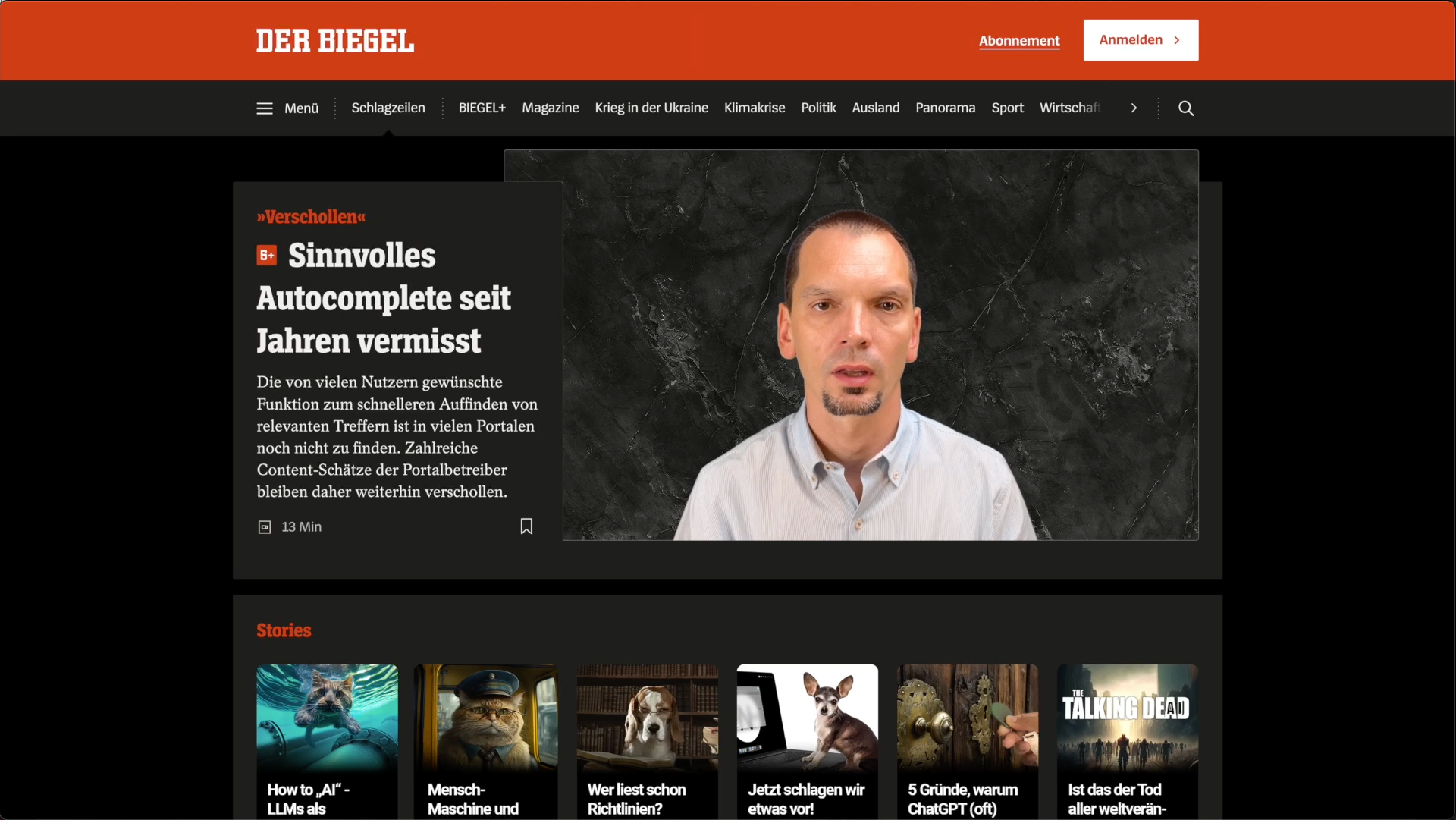
We take a look at major German media portals and how they deal with the issue of search and autocomplete. A spoiler in advance: The situation remains sad.
What is ChatGPT capable of? Instead of uncritical applause or doomsday scenarios, a level-headed look at the underlying technologies and the possibilities that arise from them.
We prefer to discuss Text AI and Natural Language Processing, but in this video we'll go over the basics. We talk about scaling, the serverless trend, and cloud-native services - all things you might be interested in.
We develop products. Whether for ourselves or for customers, we invest the same enthusiasm and have the same quality standards. How we deliver the maximum added value, we describe here.
ChatGPT may help software developers in some cases, but it won't replace them. It can be helpful to a certain degree, but its eagerness to give wrong answers can be counterproductive. (Automatically generated summary)
Web portals should go beyond offering a search function and implement Suggest features to make searching easier, more relevant and more enjoyable. This is possible by providing suggestions in different categories. (Summary generated by NEOMO summarizer)