Polite, Confident, Wrong: What a Licensing Chat Reveals About AI Support
AI chatbots in customer service almost always sound the same: friendly, helpful, and sure of themselves. That's exactly what makes them pleasant to use — and exactly why they're a problem. A confident tone says nothing about whether an answer is actually correct. A recent case from our own day-to-day work makes that very concrete.
The Question
We use a licensed music and sound-effects service for our podcast. During an active subscription, we built a roughly ten-second jingle from it, meant to open every future episode. The obvious question: could we still use that jingle in a new episode five years from now, if the subscription is no longer active by then?
A question with clear legal weight — exactly the kind of answer you'd want to be able to rely on.
Answer 1: Friendly Tone, Wrong Content
The provider's support chatbot replied instantly, in its best tone: as long as the jingle was published during an active subscription, it could keep being used in future episodes too — explicitly including a new episode published five years later with no active subscription at all.
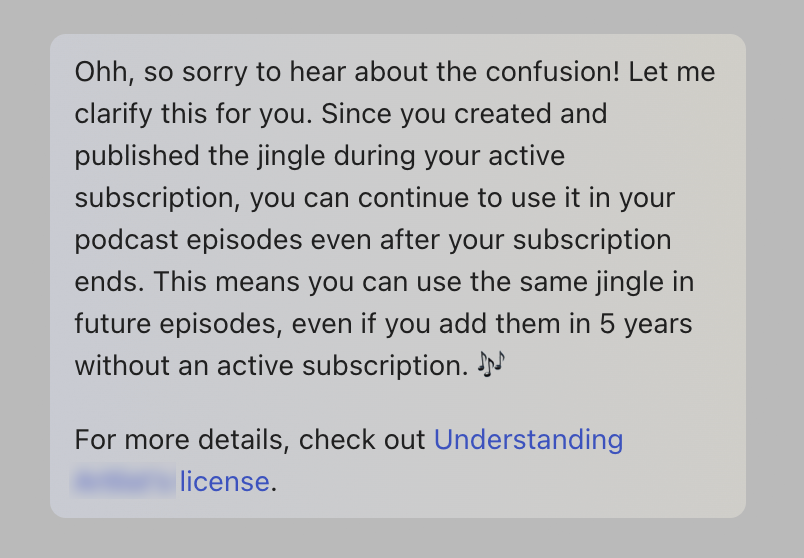
It sounded plausible. It was wrong — at least according to the answer we received from a human the next day.
Because the question was business-critical for us, we explicitly asked in the chat for human review. The bot escalated the case, and a support ticket was created.
Answer 2: The Human Clarification
The next day, a support representative replied by email — with much more precision: an episode published while the subscription is active stays covered forever, even after the subscription ends. But a *new* episode using the same jingle, published without an active subscription, is not covered. Every new publication needs an active subscription at the time it goes live.
An important distinction — and the exact opposite of what the chatbot had first claimed.
Answer 3: Same Question, One Day Later, Suddenly Correct
Out of curiosity, we asked the same chatbot the exact same question again the next day. This time the answer was correct and matched what the human representative had told us: new episodes published without an active subscription are not covered.
Whether the bot had been adjusted in the meantime, whether it was simply chance, or whether the answer varies by context isn't something we can judge from the outside. What's notable is something else: the same question, the same bot, one day apart, and two answers with very different reliability. Anyone who had trusted the first answer could have walked into a new podcast season with a licensing violation.
The Disclaimer That Quietly Undercuts Everything
Almost every AI support chat today opens with a line like: "I'm powered by AI. While I aim for accuracy, results may vary — please double-check key details for critical decisions." That sentence turned out to be highly relevant here. In practice, it means the friendly, confident tone of the answer carries no legal or practical weight whatsoever. That one sentence already fully protects the company, regardless of how convincing the answer sounds.
For users, this creates a quiet trap: the tone of the answer suggests reliability, while the legal fine print says the opposite.
What This Means for Dealing With AI Support
Three takeaways generalize beyond this one case.
First, tone is not a quality signal. Chatbots are almost always phrased politely and confidently, regardless of whether the answer is actually right.
Second, for questions with legal, financial, or otherwise business-critical implications, it's worth explicitly escalating to a human — and keeping the written confirmation.
Third, AI answers aren't necessarily consistent. The same question can get a different answer on a different day. If an answer is important enough to document, it's important enough to check twice.
For companies building AI-powered support or AI features into their own products, there's a further lesson here: a generic chatbot running on an off-the-shelf language model can fail exactly in the moments that matter most to customers. Reliability on critical questions doesn't happen automatically — it has to be deliberately engineered into the system, through clear escalation paths, vetted knowledge sources, and well-defined boundaries around where an AI is allowed to answer on its own and where it isn't.
That's precisely where we focus at NEOMO when we optimize existing processes or software solutions with AI. We deliberately don't treat a language model as an oracle answering from its own fuzzy memory, but as a tool that processes existing, vetted content. In practice, that means working from cleanly prepared source material rather than a model's open-ended recall, requiring the AI to trace every statement back to a specific passage in that source material, and explicitly allowing it to say "that's not in the documents" instead of guessing. At business-critical points, a human is also in the loop, and those source references are exactly what makes their review fast and reliable. That way, the risk of false output isn't left to chance — it's engineered into the system from the start.
Why language models don't hallucinate less often as they get smarter — just more convincingly — is the subject of the latest episode of our podcast Digitale Wissensbissen: "Je schlauer die KI, desto subtiler die Halluzinationen" ("The smarter the AI, the subtler the hallucinations," Season 2, Episode 1). Worth a listen if you're putting AI to work in business-critical processes.